Level 3 Practical Assessment
🎯 Assignment: Accept this exam on GitHub Classroom
You’ll get your own repository. Submit your code and a recording (wav, mp3, or mp4) of your live demo.
Certified Voice AI Architect
| Duration | 4 hours |
| Passing Score | 70% (automated) + manual review |
| Grading | Automated checks + instructor review |
Exam Overview
Design and implement a production-ready enterprise voice AI system demonstrating mastery of all architect-level concepts.
Scenario: TeleHealth Connect
You are architecting a telehealth voice AI system that:
- Triages patient symptoms
- Schedules appointments with specialists
- Provides medication reminders
- Handles prescription refill requests
- Routes to on-call nurses for urgent issues
Compliance Requirements
- HIPAA-compliant data handling
- No PHI in logs
- Recording consent required
- Identity verification before PHI access
Part 1: Architecture Design (20 points)
Deliverables
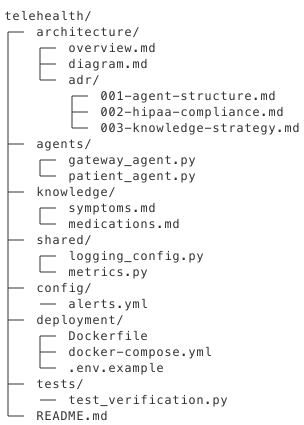
Create architecture/ directory with:
1. overview.md - System overview including:
- High-level architecture description
- List of agents and responsibilities
- Integration points
- Data flow description
2. diagram.md - ASCII or described system diagram showing:
- Agent relationships
- Data flow
- External integrations
- Security boundaries
3. adr/001-agent-structure.md - ADR for agent organization 4. adr/002-hipaa-compliance.md - ADR for HIPAA approach 5. adr/003-knowledge-strategy.md - ADR for knowledge base design
Evaluation Criteria
- Clear separation of concerns (4 points)
- Security boundaries defined (4 points)
- Scalability considered (4 points)
- ADRs explain rationale (4 points)
- Diagram accurate and complete (4 points)
Part 2: Gateway Agent (15 points)
Requirements
Create agents/gateway_agent.py:
- Route to appropriate department
- Handle after-hours routing
- Provide general information
- Implement health check
Required Functions
route_call(department)- Route to specialistget_hours()- Return operating hoursemergency_guidance()- Provide emergency info
Evaluation Criteria
- Clean routing logic (5 points)
- After-hours handling (3 points)
- Emergency handling (3 points)
- Health endpoint (2 points)
- Proper authentication (2 points)
Part 3: Patient Services Agent (25 points)
Requirements
Create agents/patient_agent.py:
- Multi-step patient verification
- Symptom triage workflow (contexts)
- Appointment scheduling (DataMap)
- Prescription refills
- Secure data handling
Required Contexts
- Verification - Verify patient identity
- Triage - Assess symptoms
- Scheduling - Book appointments
- Prescriptions - Handle refills
Required Functions
Verification:
verify_patient(dob, member_id)- Verify identity (secure)
Triage:
assess_symptoms(symptoms)- Initial assessmentescalate_urgent()- Route to nurse
Scheduling:
check_availability(specialty, date)- DataMap to scheduling APIbook_appointment(slot_id)- Confirm booking
Prescriptions:
request_refill(medication, pharmacy)- Submit refill request
Evaluation Criteria
- Verification before PHI access (5 points)
- Context workflow correct (5 points)
- DataMap integration working (5 points)
- Recording paused for sensitive data (3 points)
- Proper error handling (3 points)
- Security logging (4 points)
Part 4: Knowledge Integration (10 points)
Requirements
Create knowledge base for:
- Common symptoms and guidance
- Medication information
- Provider directory
- FAQ
Deliverables
knowledge/symptoms.md- Symptom guidanceknowledge/medications.md- Medication info- Knowledge integration in patient agent
Evaluation Criteria
- Relevant content created (3 points)
- Search skill configured (3 points)
- Appropriate use in functions (2 points)
- Fallback for unknown queries (2 points)
Part 5: Observability (15 points)
Requirements
Create shared/ directory with:
1. logging_config.py - Structured JSON logging
- Call ID correlation
- Function timing
- PHI exclusion
2. metrics.py - Prometheus metrics
- Call counters
- Function latency histograms
- Business metrics (appointments, refills)
3. config/alerts.yml - Alert rules
- Error rate alert
- Latency alert
- Business metric alerts
Evaluation Criteria
- JSON structured logs (3 points)
- Correlation IDs (2 points)
- PHI excluded from logs (3 points)
- Relevant metrics defined (3 points)
- Appropriate alert thresholds (2 points)
- Health check comprehensive (2 points)
Part 6: Deployment (10 points)
Requirements
Create deployment/ directory with:
1. Dockerfile
- Multi-stage build
- Non-root user
- Health check
2. docker-compose.yml
- All agents
- Environment configuration
- Health checks
3. .env.example
- All required variables
- Comments explaining each
Evaluation Criteria
- Dockerfile follows best practices (3 points)
- Health checks configured (2 points)
- Environment properly managed (2 points)
- Compose orchestrates correctly (2 points)
- Documentation accurate (1 point)
Part 7: Testing & Documentation (5 points)
Requirements
1. tests/test_verification.py - Test patient verification
2. README.md
- Setup instructions
- Architecture overview
- API documentation
Evaluation Criteria
- Tests cover critical paths (2 points)
- README complete (2 points)
- Setup instructions work (1 point)
Submission Structure
Grading Rubric
Automated Checks (85 points)
These checks run automatically when you push your code:
| Criteria | Points | Type |
|---|---|---|
| Gateway agent loads without errors | 5 | Automated |
| Gateway generates valid SWML | 5 | Automated |
| route_call function exists | 5 | Automated |
| Patient agent loads without errors | 5 | Automated |
| Patient generates valid SWML | 5 | Automated |
| verify_patient function exists | 5 | Automated |
| assess_symptoms function exists | 5 | Automated |
| book_appointment function exists | 5 | Automated |
| Has secure function marking | 5 | Automated |
| Has multi-context workflow | 5 | Automated |
| Has recording control | 5 | Automated |
| route_call routes correctly | 5 | Automated |
| verify_patient validates identity | 5 | Automated |
| Has agent transfer capability | 5 | Automated |
| get_hours function exists | 5 | Automated |
| request_refill function exists | 5 | Automated |
Manual Review (15 points)
After passing automated checks, an instructor will review:
| Criteria | Points |
|---|---|
| Architecture design (ADRs, diagrams) | 5 |
| Deployment configuration | 5 |
| Live demonstration recording | 5 |
Testing Commands
# Test gateway agent
swaig-test agents/gateway_agent.py --dump-swml
swaig-test agents/gateway_agent.py --exec route_call --department "triage"

# Test patient agent
swaig-test agents/patient_agent.py --list-tools
swaig-test agents/patient_agent.py --exec verify_patient \
  --dob "1980-01-15" --member_id "M123456"

# Build Docker
docker build -t telehealth:latest -f deployment/Dockerfile .

# Run with compose
docker-compose -f deployment/docker-compose.yml up

# Check health
curl http://localhost:3000/health

# Check metrics
curl http://localhost:9090/metrics
Time Management
| Phase | Suggested Time |
|---|---|
| Architecture & Design | 45 min |
| Gateway Agent | 30 min |
| Patient Agent | 75 min |
| Knowledge Base | 30 min |
| Observability | 45 min |
| Deployment | 30 min |
| Testing & Docs | 15 min |
| Review & Polish | 30 min |
Important Notes
- HIPAA Compliance: All PHI handling must follow secure patterns
- Code Quality: Clean, documented, production-ready code expected
- Testing: Verify all functions work before submission
- Documentation: Architecture decisions must be justified
Submission Instructions
- Place your gateway agent in
solution/gateway_agent.py - Place your patient agent in
solution/patient_agent.py - Create all architecture files in
architecture/directory - Create deployment files in
deployment/directory - Add your demo recording (wav, mp3, or mp4) to the repository
- Push to trigger auto-grading
- Check the “Grading Results” issue for automated feedback
Note: After automated checks pass, your submission will be tagged for manual review by an instructor.
Good luck! This exam demonstrates your readiness to architect enterprise voice AI systems.