| Duration | 2 hours |
| Day | 7 of 7 |
Learning Objectives
By the end of this module, students will be able to:
- Diagnose common voice AI issues
- Use debugging tools effectively
- Implement error handling strategies
- Build resilient agents
Topics
1. Common Issues and Symptoms (25 min)
Issue Classification
| Category | Symptoms | Common Causes |
|---|---|---|
| Connectivity | No response, timeouts | Network, auth, SSL |
| Recognition | Wrong understanding | Accent, noise, jargon |
| Logic | Wrong actions taken | Prompt issues, missing context |
| Performance | Slow responses | API delays, cold starts |
| Integration | Function failures | API errors, data issues |
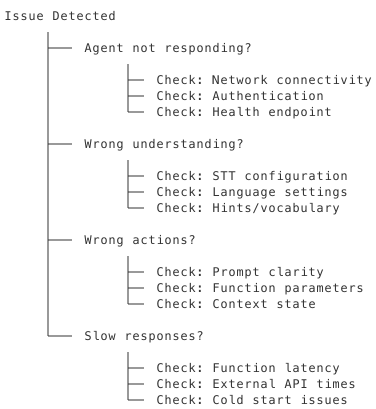
Diagnostic Decision Tree
2. Using swaig-test (30 min)
Basic Testing
# Dump SWML output
swaig-test my_agent.py --dump-swml

# List all registered tools
swaig-test my_agent.py --list-tools

# Test specific function
swaig-test my_agent.py --exec get_order --order_id "12345"

# Test with metadata
swaig-test my_agent.py --exec process_payment \
  --amount "100" \
  --meta customer_id="C001" \
  --meta verified="true"
Debugging Function Issues
# Verbose output
swaig-test my_agent.py --exec my_function --x "test" --verbose

# Check function signature
swaig-test my_agent.py --list-tools --json | jq '.[] | select(.name=="my_function")'

# Test with raw_data simulation
swaig-test my_agent.py --exec my_function \
  --query "help" \
  --raw '{"call_id": "test-123", "meta_data": {"customer": "John"}}'
SWML Validation
# Validate SWML structure
swaig-test my_agent.py --dump-swml --validate

# Check specific sections
swaig-test my_agent.py --dump-swml | jq '.sections.main[0].ai'

# Verify functions are exposed
swaig-test my_agent.py --dump-swml | jq '.sections.main[0].ai.SWAIG.functions'
3. Log-Based Debugging (30 min)
Enable Debug Logging
import logging
import os

# Enable debug logging
logging.basicConfig(
    level=logging.DEBUG if os.getenv("DEBUG") else logging.INFO,
    format='%(asctime)s - %(name)s - %(levelname)s - %(message)s'
)

logger = logging.getLogger(__name__)


class DebuggableAgent(AgentBase):
    def __init__(self):
        super().__init__(name="debuggable-agent")
        logger.debug(f"Agent initialized: {self._name}")
        self._setup_functions()

    def _setup_functions(self):
        @self.tool(
            description="Debug function",
            parameters={
                "type": "object",
                "properties": {
                    "input": {"type": "string", "description": "Input data"}
                },
                "required": ["input"]
            }
        )
        def debug_function(args: dict, raw_data: dict = None) -> SwaigFunctionResult:
            input = args.get("input", "")
            raw_data = raw_data or {}
            global_data = raw_data.get("global_data", {})
            logger.debug(f"Function called with input: {input}")
            logger.debug(f"raw_data: {raw_data}")
            logger.debug(f"Current global_data: {global_data}")

            result = process(input)
            logger.debug(f"Function result: {result}")

            return SwaigFunctionResult(result)
Run with Debug Mode
# Enable debug logging
DEBUG=1 python my_agent.py

# Or with specific logger
LOGLEVEL=DEBUG python my_agent.py
Analyzing Logs
# Filter for specific call
grep "call-123" agent.log

# Filter for errors
grep -E "(ERROR|CRITICAL)" agent.log

# Filter for function calls
grep "Function called" agent.log

# JSON log parsing
cat agent.log | jq 'select(.level=="ERROR")'

# Timeline analysis
cat agent.log | jq -r '[.timestamp, .message] | @tsv' | head -20
4. Error Handling Strategies (25 min)
Graceful Degradation
class ResilientAgent(AgentBase):
    def __init__(self):
        super().__init__(name="resilient-agent")
        self._setup_functions()

    def _setup_functions(self):
        @self.tool(
            description="Get order status",
            parameters={
                "type": "object",
                "properties": {
                    "order_id": {"type": "string", "description": "Order ID"}
                },
                "required": ["order_id"]
            }
        )
        def get_order_status(args: dict, raw_data: dict = None) -> SwaigFunctionResult:
            order_id = args.get("order_id", "")
            try:
                # Primary: Real-time API
                status = api.get_order(order_id)
                return SwaigFunctionResult(f"Order {order_id}: {status}")

            except ConnectionError:
                logger.warning(f"API unavailable, trying cache")
                try:
                    # Fallback: Cached data
                    status = cache.get(f"order:{order_id}")
                    if status:
                        return SwaigFunctionResult(
                            f"Order {order_id}: {status} "
                            "(Note: This may be slightly outdated)"
                        )
                except Exception:
                    pass

                # Final fallback: Helpful response
                return SwaigFunctionResult(
                    "I'm having trouble checking order status right now. "
                    "Would you like me to have someone call you back?"
                )

            except ValueError as e:
                logger.error(f"Invalid order ID: {order_id}")
                return SwaigFunctionResult(
                    "That doesn't look like a valid order number. "
                    "Order numbers are 8 digits. Could you check and try again?"
                )

            except Exception as e:
                logger.error(f"Unexpected error: {e}", exc_info=True)
                return SwaigFunctionResult(
                    "Something went wrong. Let me connect you with support."
                )
Retry Logic
import time
from functools import wraps


def retry(max_attempts=3, delay=1, backoff=2):
    """Retry decorator with exponential backoff."""
    def decorator(func):
        @wraps(func)
        def wrapper(*args, **kwargs):
            attempts = 0
            current_delay = delay

            while attempts < max_attempts:
                try:
                    return func(*args, **kwargs)
                except (ConnectionError, TimeoutError) as e:
                    attempts += 1
                    if attempts == max_attempts:
                        raise
                    logger.warning(
                        f"Attempt {attempts} failed: {e}. "
                        f"Retrying in {current_delay}s"
                    )
                    time.sleep(current_delay)
                    current_delay *= backoff

        return wrapper
    return decorator


class RetryAgent(AgentBase):
    @retry(max_attempts=3, delay=0.5)
    def _fetch_data(self, id: str):
        return api.get(id)

    @AgentBase.tool(
        description="Get data with retry",
        parameters={
            "type": "object",
            "properties": {
                "id": {"type": "string", "description": "Data ID"}
            },
            "required": ["id"]
        }
    )
    def get_data(self, args: dict, raw_data: dict = None) -> SwaigFunctionResult:
        id = args.get("id", "")
        try:
            data = self._fetch_data(id)
            return SwaigFunctionResult(f"Data: {data}")
        except Exception:
            return SwaigFunctionResult(
                "Unable to retrieve data after multiple attempts."
            )
Circuit Breaker
from datetime import datetime, timedelta


class CircuitBreaker:
    def __init__(self, failure_threshold=5, reset_timeout=60):
        self.failure_threshold = failure_threshold
        self.reset_timeout = reset_timeout
        self.failures = 0
        self.last_failure = None
        self.state = "closed"  # closed, open, half-open

    def call(self, func, *args, **kwargs):
        if self.state == "open":
            if datetime.now() - self.last_failure > timedelta(seconds=self.reset_timeout):
                self.state = "half-open"
            else:
                raise CircuitOpenError("Circuit breaker is open")

        try:
            result = func(*args, **kwargs)
            if self.state == "half-open":
                self.state = "closed"
                self.failures = 0
            return result

        except Exception as e:
            self.failures += 1
            self.last_failure = datetime.now()

            if self.failures >= self.failure_threshold:
                self.state = "open"
                logger.error(f"Circuit breaker opened after {self.failures} failures")

            raise


class CircuitBreakerAgent(AgentBase):
    def __init__(self):
        super().__init__(name="circuit-agent")
        self.api_circuit = CircuitBreaker(failure_threshold=3, reset_timeout=30)
        self._setup_functions()

    def _setup_functions(self):
        @self.tool(
            description="Protected API call",
            parameters={
                "type": "object",
                "properties": {
                    "query": {"type": "string", "description": "API query"}
                },
                "required": ["query"]
            }
        )
        def protected_call(args: dict, raw_data: dict = None) -> SwaigFunctionResult:
            query = args.get("query", "")
            try:
                result = self.api_circuit.call(api.search, query)
                return SwaigFunctionResult(f"Found: {result}")

            except CircuitOpenError:
                return SwaigFunctionResult(
                    "Our search system is temporarily unavailable. "
                    "Please try again in a few minutes."
                )
5. Production Debugging (30 min)
Remote Debugging Setup
import os

if os.getenv("REMOTE_DEBUG"):
    import debugpy
    debugpy.listen(("0.0.0.0", 5678))
    print("Waiting for debugger attach...")
    debugpy.wait_for_client()
Request Replay
import json
from datetime import datetime


class ReplayableAgent(AgentBase):
    def __init__(self):
        super().__init__(name="replayable-agent")
        self.request_log = []
        self._setup_functions()

    def log_request(self, function_name: str, args: dict, raw_data: dict):
        """Log request for replay."""
        entry = {
            "timestamp": datetime.utcnow().isoformat(),
            "function": function_name,
            "args": args,
            "raw_data": raw_data
        }
        self.request_log.append(entry)

        # Also write to file
        with open("requests.jsonl", "a") as f:
            f.write(json.dumps(entry) + "\n")

    def replay_request(self, entry: dict):
        """Replay a logged request."""
        func = getattr(self, entry["function"])
        return func(**entry["args"], raw_data=entry["raw_data"])


# Replay from file
def replay_from_log(agent, log_file: str):
    with open(log_file) as f:
        for line in f:
            entry = json.loads(line)
            print(f"Replaying: {entry['function']}")
            try:
                result = agent.replay_request(entry)
                print(f"Result: {result}")
            except Exception as e:
                print(f"Error: {e}")
Health Check Debugging
@app.get("/debug/health")
async def debug_health():
    """Detailed health check for debugging."""
    results = {
        "timestamp": datetime.utcnow().isoformat(),
        "checks": {}
    }

    # Agent SWML generation
    start = time.perf_counter()
    try:
        swml = agent.get_swml()
        results["checks"]["swml_generation"] = {
            "status": "ok",
            "duration_ms": (time.perf_counter() - start) * 1000,
            "function_count": len(swml.get("functions", []))
        }
    except Exception as e:
        results["checks"]["swml_generation"] = {
            "status": "error",
            "error": str(e)
        }

    # Database connectivity
    start = time.perf_counter()
    try:
        db.execute("SELECT 1")
        results["checks"]["database"] = {
            "status": "ok",
            "duration_ms": (time.perf_counter() - start) * 1000
        }
    except Exception as e:
        results["checks"]["database"] = {
            "status": "error",
            "error": str(e)
        }

    # External API
    start = time.perf_counter()
    try:
        response = requests.get(
            "https://api.example.com/health",
            timeout=5
        )
        results["checks"]["external_api"] = {
            "status": "ok" if response.ok else "degraded",
            "status_code": response.status_code,
            "duration_ms": (time.perf_counter() - start) * 1000
        }
    except Exception as e:
        results["checks"]["external_api"] = {
            "status": "error",
            "error": str(e)
        }

    # Memory usage
    import psutil
    process = psutil.Process()
    results["system"] = {
        "memory_mb": process.memory_info().rss / 1024 / 1024,
        "cpu_percent": process.cpu_percent()
    }

    return results
Troubleshooting Quick Reference
Agent Won’t Start
# Check syntax
python -m py_compile my_agent.py

# Check imports
python -c "from my_agent import *"

# Check environment
env | grep SIGNALWIRE

# Verbose startup
python my_agent.py --verbose
Function Not Called
# Verify function registered
swaig-test my_agent.py --list-tools | grep function_name

# Check SWML includes function
swaig-test my_agent.py --dump-swml | jq '.sections.main[0].ai.SWAIG.functions[] | select(.function=="function_name")'

# Test function directly
swaig-test my_agent.py --exec function_name --param "value"
Slow Performance
# Profile function
python -m cProfile -s cumulative my_agent.py

# Time external calls
curl -w "@timing.txt" -o /dev/null -s https://api.example.com/

# Check memory
python -c "import tracemalloc; tracemalloc.start(); from my_agent import *; print(tracemalloc.get_traced_memory())"
Key Takeaways
- Systematic debugging - Follow the decision tree
- Use the tools - swaig-test is your friend
- Log thoughtfully - Context and correlation
- Handle errors gracefully - Fallbacks and retries
- Monitor continuously - Catch issues before users do
Preparation for Lab 3.6
- Identify a problematic agent or function
- Gather error logs
- Note reproduction steps
Lab Preview
In Lab 3.6, you will:
- Debug a broken agent
- Fix common issues
- Implement error handling
- Add resilience patterns